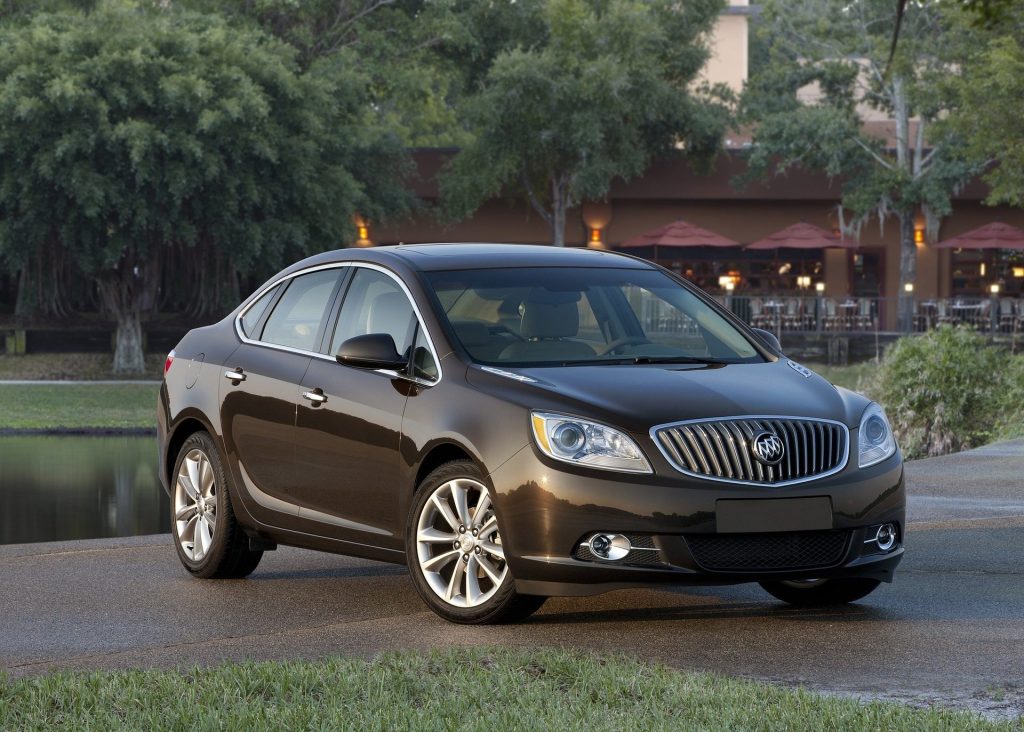
Buick thought a gussied up Chevy Cruze could go up against the likes of the Acura ILX and Mercedes CLA
Once upon a time, Buick had a full model lineup. While the brand’s current lineup consists of just four crossovers, as recently as the late 2010s, Buick still sold sedans like the Regal and Lacrosse. While GM has long since shown that the Buick’s priority is China, one of Buick’s last entries into the sedan segment was an entry level sedan that shared a bit too much with the Chevy Cruze.
Since at least the 1960s, Buick had always had a compact offering with models like the Special and Apollo. By the late 1980s and into the 1990s, Buick’s entry level offering was the Skylark (also known as the Somerset). By the mid-1990s, the Skylark had morphed into a swoopy compact sedan with styling based on a 1990 concept called Bolero. It was an interesting design to say the least. But that’s all the Skylark had going for it. Aside from using Oldsmobile’s Quad 4 engine, a Grand Sport model with an adjustable suspension and a special 1996 Olympic edition, the Skylark was a boring rental special. Production ended in 1997 after 320,000 were sold. After Skylark’s discontinuation, it would be another 14 years before Buick entered the premium compact segment again.
Rather than design something truly unique for the brand, Buick engineers looked to GM’s Delta II platform for a small car. Despite being described as “platform sharing” the result was essentially a gussied-up Chevy Cruze called the Verano. Even though it was an entry-level model, the Verano was a Buick to a certain extent. Buick made extensive use of its signature Quiet Tuning technology to give the Verano one of the quietest interiors in its class. This was done through the use of things like acoustic laminated glass, five-layer roof liner, and triple door seals. That’s as far as the Buick-ness went, however. The rest of the Verano was essentially the Cruze. It was even powered by the same 2.4-liter 180 horsepower Ecotech I4 as the Cruze.
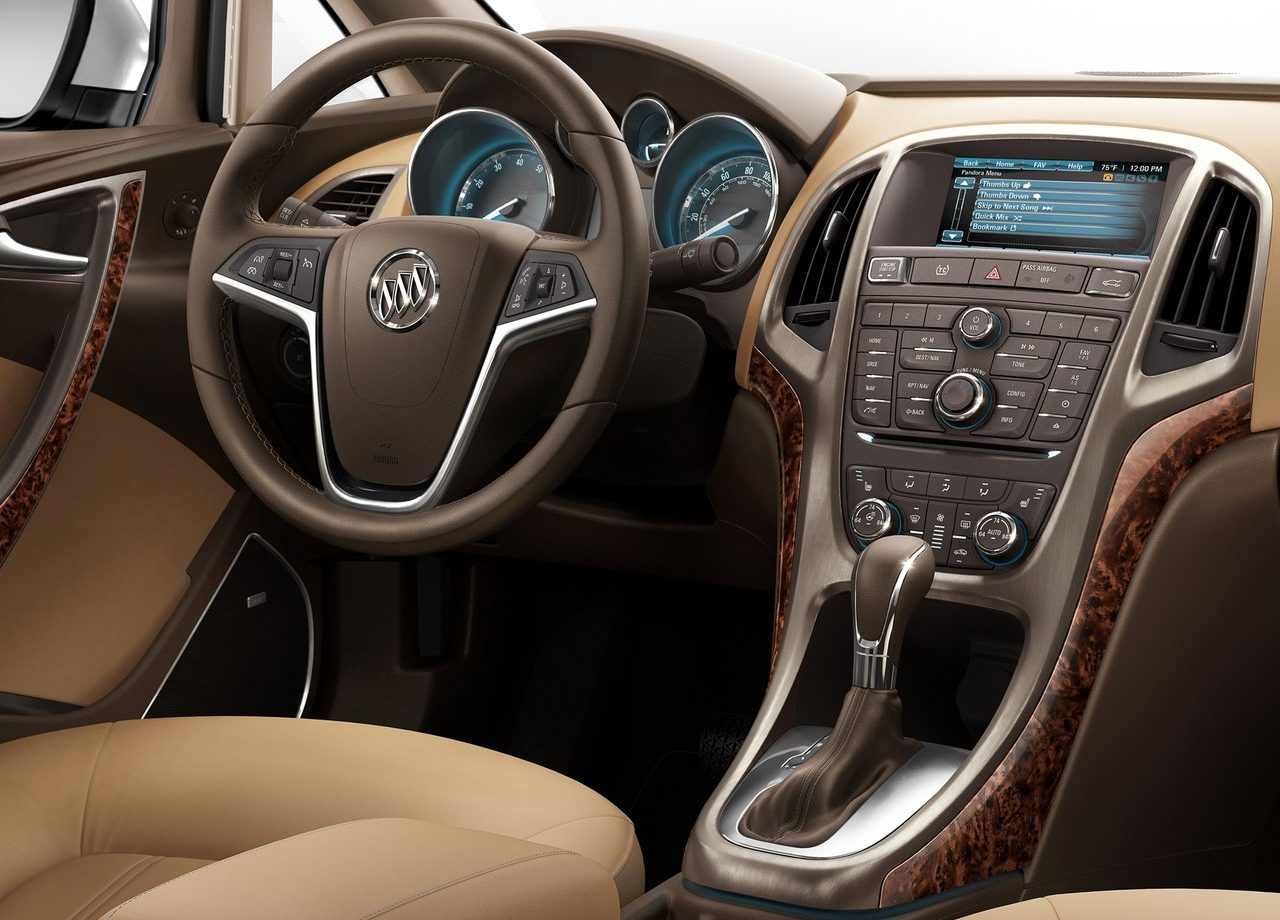 The interior was where the similarity to the Cruze really came through. While the Verano’s interior was admittedly (mostly due to interior color choices) handsome, it was damn near identical to the Cruze. Things like the gauges, climate controls, the steering wheel, and vent placement were all identical or nearly identical to the Cruze. The Verano did differ from the Cruze in one substantial way though.
Surprisingly, Buick did the Verano a solid early on in its production. In late 2012, not even a year into the Verano’s production, Buick dropped a 2.0-liter turbocharged I4 under the sedan’s hood. A detuned version of the same turbocharged I4 used in the Regal GS, it made 250 horsepower in the Verno and 260 lb-ft of torque. In another surprising move, the engine could be paired with either a six speed automatic transmission or a six speed manual. While this all made for a compact sedan that was as fast as a Regal GS, this wasn’t an enthusiast special in any way.
 Auto outlets found the car to be confusing. While the turbo engine was great when it was in its powerband, it was let down by a clunky manual transmission with long ratios; the automatic was preferred by many. The suspension also wasn’t up to the task of giving off sporty vibes. Buick engineers spent too much time tuning the ride for a boulevard, cushy ride rather than throwing on a suspension that was a bit stiffer. In a Motor Trend matchup against the similarly priced and equipped Acura ILX, Mike Floyd said he’d choose the ILX over the Verano Turbo. Mind you, the ILX was down 49 horsepower to the Verano. He continued, saying he’d have no problem recommending the Verano Turbo, it’s just that it would be something he’d recommend to his grandparents, and that the manual should be skipped altogether.
The Verano soldiered on until 2017 when it was dropped in the US because Buick preferred buyers went for the compact Encore crossover instead. The Verano is still sold in China where it’s currently in its third generation. Sadly it’s doubtful Buick will ever offer a compact entry level sedan for the North American market ever again.



Leave a comment